

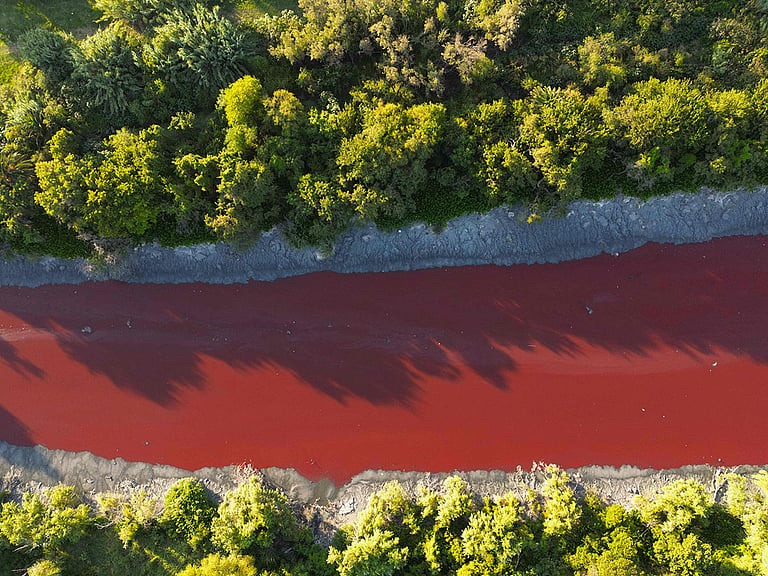
The Sarandí Stream Environmental Crisis: The Reality Behind Buenos Aires’ “Blood River”

The environmental crisis of the Sarandí Stream (Arroyo Sarandí) in Avellaneda, Buenos Aires, highlights the critical ongoing challenges facing urban waterways in high-density industrial zones.
When a major stretch of the stream—located right near the neighborhood of Villa Inflamable—suddenly turned an opaque, vivid crimson color, it exposed a long history of environmental neglect. The incident serves as a striking case study of the ecological friction between unregulated industrial manufacturing and public health.
1. The Chemistry: Aniline and Industrial Dyes
The visual shift of the water quickly drew comparisons to a “river of blood”. However, on-site sampling by local environmental teams points directly to aniline ($C_6H_5NH_2$) and concentrated chemical dyes as the primary cause of the discoloration.
[Industrial Plant / Tannery Discharge] ──> Concentrated Aniline & Dye Waste ──> Severe Discoloration & Toxin Leak
Aniline is a volatile, oily organic compound primarily used in industrial applications:
- Synthetic Dye Production: It acts as a base agent for creating intense pigments used heavily in the textile industry.
- Tanneries and Leather Processing: The Avellaneda and Matanza-Riachuelo basins host a high density of operations that process animal hides, a process that relies heavily on chemical stabilizers and colorants.
- Biological Action: When released in mass quantities, these compounds coat the water, block sunlight penetration, alter pH levels, and deplete dissolved oxygen, which severely impacts aquatic life.
2. A Chronic Microcosm of Pollution
For the residents of Avellaneda, the crimson shift is an extreme symptom of a decades-long pattern of illegal dumping. The stream runs through heavily populated neighborhoods where local chemical storage depots, waste processing incinerators, and tanneries operate in close proximity.
| Observed Water Profile | Common Contributing Industrial Source | Associated Public Health Risk |
| Blood-Red / Crimson | Textile dye spills, aniline dumping. | Acute dermatological irritation, chemical inhalation risks. |
| Neon Green / Purple / Blue | Heavy metal runoff, solvent disposal. | Chronic soil and water table toxicity. |
| Oily Film / Gray / Ash | Hydrocarbon leakage, illegal industrial waste. | Severe disruption to local marine biology. |
Residents have long filed environmental complaints, documenting a rotating carousel of toxic colors accompanied by strong, noxious odors and acidic air quality.
3. Downstream Ecological Consequences
The danger of the Sarandí Stream extends far beyond the immediate banks of Avellaneda. Because the stream functions as an open channel that eventually cuts past the Avellaneda Ecological Reserve before emptying directly into the Río de la Plata estuary, the environmental footprint expands rapidly.
[Arroyo Sarandí Source] ──> [Industrial Corridors] ──> [Ecological Reserve Buffer] ──> [Río de la Plata Estuary]
The Río de la Plata is one of the most biodiverse aquatic spaces in the region and serves as a primary source of drinking water for millions of residents across greater Buenos Aires. Untreated chemical spikes threaten fragile wetlands, cause heavy metals to accumulate in regional fish populations, and complicate municipal water treatment infrastructure.
4. The Regulatory and Accountability Push
The visual nature of this event has re-energized demands for corporate accountability and systemic regulatory updates in South American industrial hubs. Local activist groups and environmental agencies are pushing for key enforcement mechanisms:
- Rigorous Environmental Audits: Moving beyond reactive sampling toward unannounced, real-time tracking of corporate wastewater discharge pipelines.
- Permanent Monitoring Systems: Installing digital water-monitoring sensors along the basin to catch chemical spikes the moment they enter the waterway.
- Strict Legal Penalties: Amending local environmental frameworks to introduce substantial fines and corporate closures for illegal toxic waste disposal.
The incident highlights that without continuous, proactive government enforcement, urban waterways will continue to bear the toxic burdens of industrial cost-cutting, turning valuable natural ecosystems into open-air chemical drains.
The environmental crisis surrounding the Arroyo Sarandí is not merely a localized issue of water quality; it is a profound manifestation of the tension between industrial output and the right to a healthy environment. By examining this “crimson shift” through the lens of environmental law and public health, we can better understand the systemic failures that allow such toxic events to persist.
Systemic Failures in Oversight
The primary driver of the contamination in the Avellaneda basin is a persistent gap in the “polluter pays” principle. While regulations exist on paper, the enforcement landscape is often fragmented:
The Enforcement Gap: Local inspectors are frequently overwhelmed by the sheer number of small-to-medium industrial operations, many of which operate in clandestine shifts to evade detection.
Legacy Infrastructure: Much of the industrial discharge originates from older facilities that lack modern water-treatment technology, making it cheaper to dump waste directly into the stream than to invest in compliant disposal systems.
Transboundary Governance: Because the Sarandí Stream crosses municipal boundaries, jurisdictions often shift blame, allowing illegal dumpers to exploit the gaps between local and provincial oversight.
The Human Cost
The proximity of communities like Villa Inflamable to these industrial corridors creates a cycle of chronic health exposure. Beyond the immediate irritation caused by chemical vapors, residents face long-term risks associated with the accumulation of heavy metals and organic toxins in the local ecosystem. These substances do not simply wash away; they settle into the sediment and infiltrate the water table, creating a “legacy of toxicity” that remains even after the water regains its transparency. This creates a disproportionate health burden on marginalized populations who reside in the immediate vicinity of the industrial discharge points.
A Path Toward Environmental Restoration
To mitigate these hazards, local advocacy groups and environmental engineers are increasingly championing a “Nature-Based Solution” approach to augment current regulatory efforts:
1. Constructed Wetlands: Creating “bio-filters” using specific native aquatic vegetation at key discharge points to naturally absorb and neutralize pollutants before they reach the larger estuary.
2. Community-Led Science: Integrating citizen-science initiatives where residents are equipped with low-cost, portable sensors to report illegal dumping in real-time, effectively creating a decentralized, community-wide surveillance network.
3. Industrial Symbiosis: Incentivizing a transition where industrial byproducts from one factory (e.g., thermal waste or chemical residues) are repurposed as raw materials for another, effectively closing the waste loop and reducing the volume of effluent released into the stream.
The crimson waters of the Sarandí serve as a stark visual indictment of a model that prioritizes industrial convenience over ecological integrity. Transforming this waterway will require more than just cleaning up a single chemical spill; it necessitates a fundamental restructuring of the relationship between industrial production, governmental oversight, and the communities that bear the environmental cost of the status quo.