
Legacy Law, and the Battle Over U.S. Currency
The intersection of currency, national legacy, and modern political movements has always been a flashpoint in American history. Following the shocking and highly polarizing assassination of conservative activist and Turning Point USA co-founder Charlie Kirk on September 10, 2025, at Utah Valley University, the debate over how to commemorate influential cultural figures has reached the halls of the United States Congress.
On September 26, 2025, Representatives Abe Hamadeh (R-AZ) and Republican Study Committee (RSC) Chairman August Pfluger (R-TX) officially introduced H.R. 5580: The Charlie Kirk Commemorative Coin Act. The legislative push seeks to direct the United States Mint to strike a limited run of legal-tender silver dollar coins honoring the late activist. The bill has sparked a profound national dialogue stretching far beyond the world of coin collecting, touching upon themes of political violence, free speech, and the historical standards used to immortalize citizens on American legal tender.
The Genesis of H.R. 5580: Honoring a Conservative Titan
The legislative momentum behind H.R. 5580 directly stems from the sudden and tragic nature of Kirk’s passing at the age of 31. As the chief fundraiser and public face of Turning Point USA, Kirk built a massive grassroots infrastructure spanning over 3,500 chapters across high school and college campuses. His specialty was entering hostile cultural environments—specifically university campuses—to host open, unscripted debates with ideological opponents.
Following his death, which was widely condemned by leaders across the political spectrum as a horrific symptom of escalating domestic political violence, his congressional allies sought a permanent, historic tribute. Representatives Hamadeh and Pfluger framed the coin act not merely as a localized memorial, but as a statement of national resilience in defense of the First Amendment freedoms Kirk championed.
If the bill successfully passes both houses of Congress and is signed into law by the President, it will mark an unprecedented milestone: Charlie Kirk would become the youngest American ever immortalized on official U.S. commemorative currency, joining a highly exclusive lineage of historical figures that includes George Washington, Alexander Hamilton, Susan B. Anthony, and civil rights heroes like Rosa Parks.
Technical and Production Specifications of the Kirk Silver Dollar
Commemorative coins produced by the United States Mint are meticulously regulated, and H.R. 5580 outlines strict physical and financial parameters to ensure the project meets the highest numismatic standards without burdening American taxpayers.
1. Production Volume and Physical Composition
The legislation mandates that the U.S. Mint produce a maximum of 400,000 one-dollar silver coins during the 2026 production cycle. In strict accordance with historical minting standards, each legal-tender coin must:
- Weigh exactly 26.73 grams.
- Measure 1.500 inches in diameter.
- Contain a minimum composition of 90% pure silver.
- Be issued in both pristine uncirculated and mirror-like proof qualities.
2. Iconography and Symbolic Design
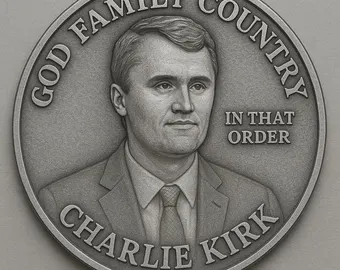
The obverse (front) side of the coin is designed to feature a detailed portrait likeness of Charlie Kirk. The reverse (back) side is designated to bear a deeply meaningful inscription to his followers and family: “Well done, good and faithful servant.” This phrase, rooted in biblical scripture, was chosen to reflect Kirk’s overt integration of his Christian faith with his political activism. The coin will also display standard, mandatory statutory inscriptions including “Liberty,” “In God We Trust,” and “United States of America.”
3. The Zero-Taxpayer-Cost Mandate
A crucial element of the bill designed to ease its passage through committee is its self-funding mechanism. By law, the production, design, and distribution of these coins cannot result in any net cost to the federal government. The Treasury Department will sell the coins to collectors and the public at a premium price that fully covers all manufacturing overhead. Furthermore, once all production costs are recouped, any remaining surcharges collected from sales are legally mandated to be distributed to nonprofit entities dedicated to promoting civic education and First Amendment awareness.
The Legal and Cultural Hurdle: The Thayer Amendment Tradition
Despite the intense grassroots support from conservative circles, H.R. 5580 faces a monumental uphill battle on Capitol Hill due to deeply rooted currency traditions and statutory guidelines.
The primary legal roadblock is a historical precedent dating back to the Civil War era: The Thayer Amendment of 1866. Passed to prevent sitting politicians from using the federal mint as a tool for personal propaganda or self-aggrandizement, this statute explicitly prohibits the depiction of any living person on circulating U.S. currency or government securities.
While Kirk’s tragic passing technically means his inclusion does not violate the literal text of the Thayer Amendment, critics of the bill argue that it violates the spirit of the tradition. Historically, Congress has waited decades, or even centuries, after an individual’s lifetime before authorizing their image for legal tender. This buffer period allows historical perspective to mature, ensuring that individuals placed on currency represent long-term, universally recognized contributions to the fabric of the republic rather than immediate, emotionally charged political reactions.
The Political Debate: Convergence of Free Speech and Currency
The introduction of H.R. 5580 has predictably divided the House of Representatives along sharp ideological lines, turning the House Financial Services Committee into a rhetorical battlefield.
The Arguments for Approval
Proponents of the bill argue that Kirk’s impact on the mobilization of American youth and the defense of campus free speech warrants an extraordinary, swift tribute. They contend that the coin acts as a vital cultural symbol against the rise of political violence, sending a clear message that ideological leaders will not be erased by acts of cowardice. Supporters also highlight that the coin is entirely voluntary and market-driven; taxpayers are not forced to fund it, and only collectors who value Kirk’s legacy will choose to purchase it.
The Arguments for Opposition
Opponents argue that using the United States Mint to honor a modern, highly polarizing political commentator sets a dangerous and slippery precedent. Critics suggest that currency should remain an arena reserved exclusively for consensus historical figures—such as founding fathers, military commanders, and monumental heads of state. They express concern that passing H.R. 5580 could open the floodgates for future congresses to routinely introduce coin acts for media personalities, talk-show hosts, and partisan activists, ultimately cheapening the prestige historically associated with American coinage.
Current Legislative Status and the Collector’s Market
As of mid-2026, H.R. 5580 remains under review by the House Committee on Financial Services. For the bill to reach the house floor for a full vote, it must clear intense committee debates and secure substantial co-sponsorship.
Regardless of whether the bill successfully passes into law, the mere introduction of the legislation has had an explosive impact on the private collector’s market. Independent manufacturers and private mints have rushed to fulfill the massive cultural demand, releasing their own unofficial silver-plated challenge coins, memorial rounds, and lapel pins through online marketplaces like Etsy and eBay.
Ultimately, the fierce debate surrounding the Charlie Kirk Commemorative Coin Act proves that currency is far more than a simple medium of economic exchange. Every coin struck by a nation acts as an enduring historical monument, reflecting the values, struggles, and defining cultural battles of the era that forged it.